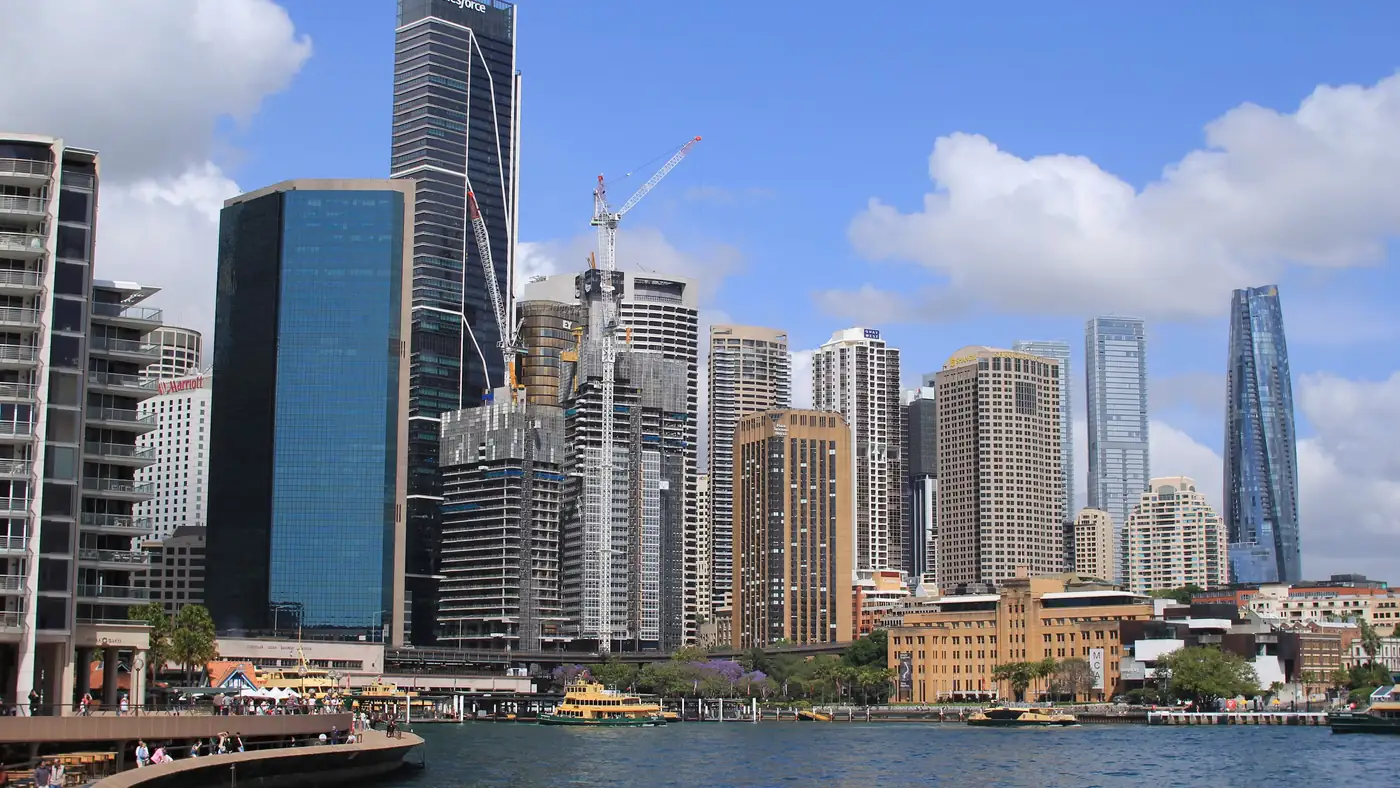
Sydney mid-market business valuations rise on private equity
Private equity demand is pushing Sydney mid-market business valuations higher as buyers compete for companies with recurring revenue and strong cash flows.
7 min read

The ASX 200 has slipped to a two-month low as sector rotation accelerates and the RBA's hawkish outlook weighs on investor sentiment nationwide.

Business & Markets Desk is a contributing writer covering business and public affairs for The Sydney Times.
The S&P/ASX 200 closed at 8,642 points on Friday, its lowest level since mid-July, as a broad-based sell-off erased $48 billion in market value across the session. The benchmark index has now fallen 6.8 percent from its August peak of 9,273 points, with investors rotating out of technology and resources stocks at the fastest pace since the March 2025 correction. The decline reflects a convergence of pressures: the Reserve Bank of Australia's hawkish rhetoric, a sharp reassessment of growth stock valuations, and weakening commodity prices that have battered the mining sector.
The materials sector led the decline, shedding 3.2 percent as iron ore futures slipped below US$95 a tonne on concerns about Chinese demand. BHP Group shares fell 2.8 percent to $58.90, while Rio Tinto dropped 3.1 percent to $163.45. Gold miners were similarly pressured, with Northern Star Resources down 4.2 percent and Evolution Mining losing 3.9 percent. The resources sector's weakness is compounded by a softening outlook for bulk commodities, which had been supported by resilient Chinese steel production through the first half of 2026.
Technology stocks extended their slide, with the S&P/ASX 200 Information Technology index falling 2.6 percent. Afterpay owner Block Inc declined 3.4 percent, while Xero Ltd dropped 2.9 percent. The sell-off in growth stocks mirrors a global pattern driven by rising real yields, which reduce the present value of future earnings and disproportionately penalise companies whose valuations depend on long-duration cash flows. The Australian Bureau of Statistics reported that business investment in intellectual property products grew just 1.2 percent in the June quarter, signalling that corporate spending on technology may be cooling faster than analysts anticipated.
Financials provided a rare bright spot, with the major banks posting modest gains. Commonwealth Bank of Australia rose 0.4 percent to $152.80, benefiting from the higher interest rate environment that supports net interest margins. The divergence between financials and the growth sectors underscores the market's defensive repositioning, as investors favour companies with near-term earnings visibility over those reliant on future growth assumptions.
The Reserve Bank of Australia has maintained its hawkish posture through September, with Governor Michele Bullock signalling that the board remains prepared to tighten policy further if inflation fails to moderate. The RBA's August Statement on Monetary Policy projected headline inflation of 3.2 percent for the December quarter, above the 2 to 3 percent target band, and warned that upside risks to the inflation outlook had intensified. According to the Reserve Bank of Australia monetary policy statement, the board judged that the balance of risks had shifted toward higher inflation, a position that has unsettled equity investors.
The cash rate has been held at 4.35 percent since November 2023, but futures markets are now pricing a 65 percent probability of a 25-basis-point hike by December. The Australian Securities Exchange reported that ASX 30-day interbank cash rate futures implied a terminal rate of 4.60 percent by March 2027, up from 4.35 percent priced just four weeks ago. This repricing has been driven by stronger-than-expected services inflation and a tight labour market, with the ABS reporting unemployment at 4.2 percent and wage growth running at 3.8 percent annually.
The hawkish stance creates a challenging environment for equities. Higher rates increase borrowing costs for leveraged companies, compress valuation multiples, and make fixed income more attractive relative to stocks. For Australian investors holding diversified portfolios, the combination of a rising rate outlook and a weakening equity market presents a difficult trade-off between capital preservation and growth.
The ASX 200's break below its 50-day moving average of 8,890 points is a technically significant development that could trigger further selling from systematic and trend-following funds. The index's relative strength index has fallen to 34, approaching oversold territory, but momentum indicators suggest the decline may not yet be exhausted. Volume on the sell-off was 18 percent above the 30-day average, indicating genuine distribution rather than a thin-market drift.
For the remainder of 2026, the outlook hinges on three factors. First, the RBA's next decision on 29 September will be pivotal. A hold with a hawkish statement would likely extend the rotation into defensives, while an unexpected hike could trigger a deeper correction. Second, commodity prices need to stabilise for the resources sector to find a floor. Third, the US Federal Reserve's September meeting will influence global risk appetite and capital flows into Australian equities.
The sector rotation away from growth and resources toward financials and defensives is likely to persist through the fourth quarter. Australian investors should expect continued volatility as the market reprices the trajectory of interest rates and corporate earnings. The two-month low is not merely a technical milestone but a signal that the macro regime has shifted, and portfolio positioning must adapt accordingly. For ongoing market coverage, visit Business & Markets.
According to the ASX daily trading report, the breadth of the decline, with decliners outnumbering advancers by more than three to one, confirms the broad nature of the repositioning. The ABS consumer price index data for the September quarter, due for release in late October, will provide the next critical input for both the RBA and equity markets.
Direct inquiries, corrections, or documentation concerning this dispatch to our editorial newsroom desk.
Private equity demand is pushing Sydney mid-market business valuations higher as buyers compete for companies with recurring revenue and strong cash flows.
The International Convention Centre Sydney will install the largest solar farm in any CBD in the Southern Hemisphere, reinforcing Sydney's renewable...

The ASX 200 fell to a two-month low in September 2026, erasing annual gains as surging bond yields and rising oil prices triggered a flight from mining...

The ASX 200 shed $32 billion in its worst session since June as oil surged past $US101 a barrel and Middle East tensions escalated, stoking inflation...