
Sydney Culture: Sydney Festival 2027: The Create NSW supports
The Sydney Festival 2027 programme is being curated to showcase the best in contemporary and traditional arts, featuring international and local talent.
6 min read

The 24th Biennale of Sydney opened in March 2026 across three main venues, bringing 69 artists from 36 countries to Cockatoo Island, the Art Gallery.
Culture & Escapes Desk is a contributing writer covering culture and public affairs for The Sydney Times.
The 24th Biennale of Sydney opened in March 2026 across three main venues, bringing 69 artists from 36 countries to Cockatoo Island, the Art Gallery of NSW and the Museum of Contemporary Art Australia. The exhibition, curated by Cosmin Costinaș and Inti Guerrero, runs until mid-June and is structured around questions of sovereignty, ecological survival and the political conditions that shape artistic practice.
The biennale's centrepiece remains Cockatoo Island, where 18 large-scale installations occupy the former convict barracks, the underground grain silos and the waterfront wharves. The island's industrial decay provides a natural frame for work that engages with extractive economies, forced displacement and the politics of land use. Several pieces respond directly to the island's history as a colonial penal site, using archival material, sound and moving image to trace continuities between the convict era and contemporary immigration policy.
The Art Gallery of NSW hosts the biennale's indoor program across the lower level of the historic building and the adjacent Sydney Modern Project wing. The Sydney Modern building, opened in 2022, provides double-height galleries and a series of interlinked rooms that accommodate large-scale sculpture, film installations and architectural interventions. The gallery's collection of Aboriginal and Torres Strait Islander art sits alongside the biennale commissions, creating a dialogue between contemporary international practice and First Nations work.
The exhibition at the Art Gallery of NSW includes a major commission by the Yolngu artist collective Mulka Project, which has produced a series of prints and moving-image works documenting Indigenous ranger activities in North East Arnhem Land. The work occupies a dedicated gallery on the lower level and is accompanied by a public program of talks and workshops running through the biennale's duration. Another significant presentation is a group of works by Japanese artist Aiko Miyawaki, whose geometric wall paintings respond to the architecture of the Sydney Modern building.
Cockatoo Island requires a ferry or water taxi from Circular Quay, with services departing every 20 to 30 minutes during exhibition hours. The island's terrain is rugged, with steep paths between venues and exposed waterfront locations that make some installations difficult to access for visitors with mobility impairments. The organisers have provided a shuttle bus between the main entry point and the more remote sites, but the service runs on a 15-minute interval and does not cover the full extent of the island.
The island's grain silos, excavated into the sandstone, host a series of sound and light works that use the subterranean space as an acoustic chamber. The most talked-about installation is a room-scale projection by the Danish-Icelandic artist Olafur Eliasson, which casts shifting patterns of coloured light across the silo walls while a low-frequency hum resonates through the stone floor. The work is deliberately disorienting, and visitors with claustrophobia or sensory sensitivities should consider whether the enclosed space is suitable before entering.
The Sydney Modern Project has reshaped how the Art Gallery of NSW presents large-scale contemporary exhibitions. The building's design, by SANAA architects, strips back internal walls to create flexible gallery spaces that can accommodate installations of varying scale. Natural light enters through clerestory windows and skylights, and the building's outdoor terraces provide additional exhibition space for sculpture and site-responsive work.
For the biennale, the Sydney Modern building hosts a series of smaller galleries that present work on paper, photography and video. The upper level includes a dedicated space for artist books and printed matter, with a reading room that is open to the public during gallery hours. The building also houses the biennale's education program, which runs guided tours, hands-on workshops and artist talks throughout the exhibition period.
The Biennale of Sydney 2026 runs from 7 March to 15 June 2026. Cockatoo Island is accessible by public ferry from Circular Quay, with services operated by Transport for NSW. The Art Gallery of NSW is a 20-minute walk from Circular Quay or a five-minute bus ride along Art Gallery Road. Entry to the biennale is free at all venues, with donations accepted at the door. Guided tours run daily at 11am and 2pm at both Cockatoo Island and the Art Gallery of NSW, with no booking required for groups under 15.
The Biennale of Sydney is supported by the NSW Government through Create NSW and Destination NSW. The exhibition's official website is at biennaleofsydney.art. For opening hours, accessibility information and current exhibition updates, visit the Art Gallery of NSW Biennale page. Cockatoo Island ferry timetables are published at transportnsw.info.
Direct inquiries, corrections, or documentation concerning this dispatch to our editorial newsroom desk.
The Sydney Festival 2027 programme is being curated to showcase the best in contemporary and traditional arts, featuring international and local talent.

With dates confirmed and Expressions of Interest open, the festival is already generating excitement across the arts community and among visitors.

The programme features productions at the Sydney Opera House, the Wharf Theatre, and the Seymour Centre, alongside independent venues across the city.
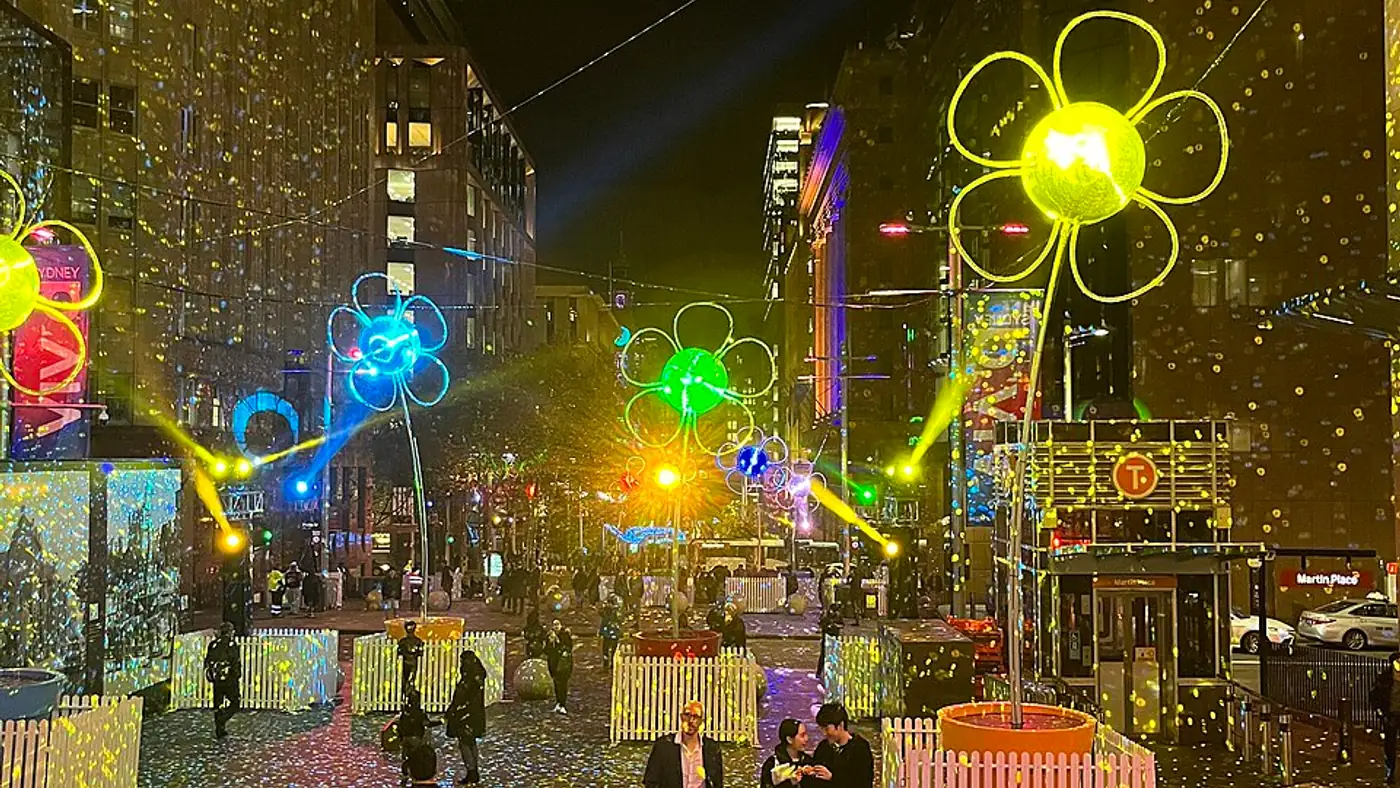
Vivid Sydney 2026 opens across Circular Quay and the CBD, featuring 90 light installations and projections from artists across five continents.